Categories
Our stories Our Voices

Botswana and Ghana Show How Africa’s Mining Agenda Is Moving Inward

Botswana and Ghana Show How Africa’s Mining Agenda Is Moving Inward

scroll for more

By Thuso Tseetse and Reindolf Ofosu-Hene

It is often said that Africa holds close to a third of the world’s known reserves of the minerals essential to the energy transition and to emerging industrial technologies. The figure appears so frequently in policy papers and investor decks that it has become almost rhetorical, a shorthand for potential rather than a measure of realised strategy. But that is beginning to shift, at least at a discernibly faster pace.

Over the past year, policymakers across several of the continent’s major producers have advanced new mining frameworks built around local content and domestic participation. The aim is to draw processing and manufacturing capacity closer to the resource, creating beneficiation within national economies and attracting investment into the wider mining ecosystem rather than into extraction alone.

The direction has been welcomed by those who see it as a long-overdue alignment between resource ownership and national development. It remains important to attract capital and create a friendly  investor environment for mining and  capital-intensive projects.

Countries like Botswana and Ghana have become emblematic of policies and strategies designed to strengthen the mining industry by building national participation, diversifying away from historically dominant commodities, and improving regulatory coherence.

Botswana, for example, is actively diversifying its mining sector beyond diamonds, largely in response to sustained headwinds in the diamond market. Diamonds still dominate the economy – accounting for about 80% of export earnings, one-third of fiscal revenue, and roughly a quarter of GDP – making Botswana the world’s largest diamond producer by value. But policy and investment attention are now shifting toward critical minerals such as copper, nickel, soda ash, salt, manganese, lithium, uranium, and gold, driven by global demand for clean-energy inputs. Exploration activity in the Kalahari Copper Belt and Tati Greenstone Belt has intensified, increasingly supported by new geological and data-driven techniques, with multinational firms such as BHP and domestic operators committing capital to battery-metal and gold projects intended to move the industry closer to value addition and long-term sustainability.

In October of 2025,Botswana’s Mines and Minerals (Amendment) Act No 14 of 2024 officially came into effect, introducing reforms to promote beneficiation and enhance citizen participation in the country’s mining industry. Among its provisions: a 24% citizen equity participation requirement – including a clause that, if the State does not exercise its interest, the block must be offered to citizens or citizen-owned companies; and a mandatory environmental rehabilitation trust fund or financial guarantee from a Botswana-registered bank. For investors, Botswana’s trajectory offers a study in how regulatory tightening can coexist with opportunity.

The country retains one of the most liberal financial regimes in Africa, with no exchange controls and straightforward capital repatriation, which simplifies cross-border investment structures. Its political stability and consistent policy execution continue to rank it among the continent’s most reliable jurisdictions for mining capital.

New opportunities are emerging for investors attentive to the ecosystem outside extraction. Skills development and technology adoption are becoming priority areas, with increasing use of AI-driven exploration, digital geological modelling, and automation to improve safety, efficiency, and resource recovery while reducing costs.

The same can be seen in Ghana. Last year, Africa’s top gold producer announced plans to shorten mining licence durations and introduce direct revenue-sharing with local communities – its most far-reaching overhaul of mining law in nearly two decades. The reforms aim to tighten accountability and anchor mining benefits more visibly in local economies. Licences will be time-bound rather than open-ended, with renewal tied to environmental, social, and production performance. Revenue flows, once centralised, will now be partially redirected to host communities through fixed-percentage contributions, replacing the older system of discretionary development agreements. The framework also proposes a clearer licensing structure for mid-tier operators and a review of stability agreements, aligning fiscal terms more closely with project lifecycles. The other side is the existence of the local content law, which prescribes that certain aspects of mining activities are the preserve of Ghanaian owned entities. E.g. all surface mining contract activities are the preserve of 100% owned Ghanaian companies. For underground mining operation, ownership must be not less than 30%.

At the same time, policymakers are acutely aware of the risk that comes with Ghana’s dependence on gold, which accounts for close to 90% of total mineral export revenue. High prices have shielded the economy in recent years, but they also mask the vulnerability of relying on a single commodity exposed to global cycles and geopolitical shifts. In response, government strategy has turned toward broadening the mineral base. Lithium discoveries in commercial quantities have opened a new frontier, though subdued international prices have delayed full-scale development. The state has also renewed focus on manganese and bauxite, directing new investment into production and downstream capacity, while exploration for copper is beginning to attract interest from both domestic and international firms.

The underlying intent is clear: to use the current gold windfall to finance a transition toward a more balanced and resilient mining economy.

These reforms, combined with a more stable macroeconomic environment, have strengthened Ghana’s investment climate. The recent appreciation of the cedi and the rebuilding of foreign reserves have improved financial predictability, while policy has remained pragmatic and growth oriented. For investors, this signals a jurisdiction where regulation and macro management are beginning to reinforce each other; a market in which both capital and long-term participation can be reasonably protected.

What is unfolding in Botswana and Ghana forms part of a broader continental pattern, and it is being shaped with intent.

Last year, the African Union released its Africa’s Green Minerals Strategy, a plan to use the continent’s mineral wealth to drive value addition at source, regional industrialisation, and climate resilience. The strategy recognises that Africa must move beyond raw exports and build integrated value chains that support jobs, skills, and diversified growth.

What stands out is that the continent is not closing itself to global capital in the process. It is making partnership more transparent, access more structured, and alignment with national priorities more deliberate – reshaping the terms of engagement between African resource holders and international investors. For those able to adjust to this new order, Africa’s mining sector offers the chance to participate in one of the most important industrial transitions of the coming decades.

Thuso Tseetse, Head of Natural Resources, Botswana and Reindolf Ofosu-Hene, Head of Natural Resources, Ghana at Absa CIB


Categories
Our stories Our Voices

How Africa Can Turn Fragmented Mineral Belts into Coherent Regional Value Chains

How Africa Can Turn Fragmented Mineral Belts into Coherent Regional Value Chains

scroll for more

By Shirley Webber and Stephen Seaka

In 2023, a mine operating along the Central African Copperbelt moved its first test consignment through the Lobito Corridor, using the refurbished rail spine that links the Democratic Republic of Congo to Angola’s Atlantic coast. Roughly 1100 tonnes of copper concentrate from the Kamoa-Kakula complex in Kolwezi were loaded at the Impala Terminals facility and sent west by rail to the Port of Lobito. The journey took eight days. Until this trial run, more than nine-tenths of the mine’s output had been routed through Durban or Dar es Salaam, where a single turnaround typically stretched to six weeks.

Angola, the DRC, and Zambia have positioned the corridor as a flagship, with financial and political backing from the United States, Italy, the European Union, and a coalition of multilateral financiers under the G7’s Partnership for Global Infrastructure and Investment and the EU’s Global Gateway. The goal is to create an alternative westward route for copper and cobalt exports, reducing dependence on longer paths through South African and East African ports, lowering transport times, and de-risking supply for battery and clean-energy manufacturers.

Seen from within the continent, though, Lobito matters for another reason.

It shows how a corridor can become the organising unit of industrial strategy, because the infrastructure that moves ore and the systems that govern its movement naturally operate beyond national borders. It also forces a more fundamental question onto the table: if the next generation of global industry is going to draw on Africa’s critical minerals, what scale of planning can genuinely support that opportunity? In practice, the geology is regional, but industrial policy is still national. Lobito exposes that mismatch and demonstrates how coordinated corridors can begin to bridge it.

Africa holds close to a third of the world’s known reserves of future-facing minerals. These include the metals driving the global energy transition – copper, cobalt, manganese, graphite, nickel, lithium and the platinum group metals – as well as a broader suite of inputs used in advanced manufacturing and emerging digital technologies, from rare earth elements to titanium and vanadium. But they are dispersed: copper and cobalt across the Central African Copperbelt; lithium, nickel and graphite across Southern Africa; manganese and PGMs across South Africa, Botswana and Zimbabwe; bauxite concentrated in Guinea; and rare earth prospects emerging through Namibia and parts of East Africa.

With the IEA projecting sharply higher demand for key battery metals and transition-linked commodities over the next two to three decades, Africa’s mineral endowment places it at the centre of an emerging geopolitical and industrial reordering.

This makes the case for regional thinking almost self-evident, at least one would think.

But many continental strategies blur the distinction between regional cooperation and regional approaches to beneficiation. Regional cooperation is about how states organise the rules of the game across borders. It includes tariff alignment, customs procedures, rail and port concessions, environmental and social standards, power-pool governance, dispute-resolution mechanisms and the regulatory treatment of long-term PPPs. Regional beneficiation, by contrast, is about where along the value chain different activities sit and how those activities are sequenced. Ore can be crushed, concentrated, smelted, refined, turned into precursors, assembled into components and eventually integrated into finished products. Some of these steps require substantial power and water; some are knowledge-intensive; some are highly trade-exposed and shaped by logistics costs. It seldom makes sense to duplicate each step in every country that hosts a deposit. It is more efficient to map which segments of a copper-cobalt-manganese-lithium chain should sit in which locations along a corridor, then design fiscal regimes, power investments, and skills programmes accordingly.

The continental policy landscape is beginning to move in this direction. The African Union’s Green Minerals Strategy positions critical minerals as a regional industrialisation opportunity and promotes integrated value chains and corridor-based infrastructure planning. The Regional Economic Communities – SADC, COMESA, ECCAS and others – provide sub-continental platforms that could support this kind of coordination, although their mining and industrial frameworks are uneven. Nonetheless, they offer the institutional footing on which more deliberate regional planning can be built.

In practice, turning these frameworks into functioning corridors requires a different discipline from governments. It means treating a corridor as a single planning unit for power, water, data connectivity and skills, even while it traverses several jurisdictions. It means aligning fiscal terms enough to prevent destructive competition for smelters and refineries, while allowing differentiated incentives where countries have distinct industrial strengths. It also demands joint approaches to environmental and social governance, so that high standards become a feature of the corridor rather than a source of regulatory arbitrage. These elements form the operational foundation on which regional value-chain design can take shape.

The private sector sits at the centre of whether this works. Mining companies and their supply chains will not commit to multi-decade smelting or refining investments unless they see predictable corridor-wide frameworks on transport, power pricing, fiscal regimes and environmental standards. Battery and EV manufacturers will only treat African corridors as strategic production nodes if they can access sufficient scale, consistent quality and credible delivery timelines. Regional banks and DFIs will structure project finance and corporate facilities more confidently when risk is shared across a corridor with pooled revenue streams rather than tied to the fiscal position of a single sovereign.

Africa does not have the luxury of treating regional cooperation and regional beneficiation as afterthoughts.

If the continent continues to negotiate in small, fragmented units, the result will be a patchwork of export restrictions and incentive schemes that strain investor confidence without building the connective tissue of shared infrastructure and industrial capacity. If, instead, leaders use projects such as the Lobito Corridor as prototypes for how to align geology, logistics, and industrial policy at a regional scale, the continent can begin to shape global value chains rather than simply feeding into them.

Shirley Webber, Coverage Head for Resources & Energy and Stephen Seaka, Managing Executive for Public Sector & Growth Capital Solutions at Absa CIB

Categories
Our stories Our Voices

Africa’s Capital Markets Are Moving Again. Here’s How.

Africa’s Capital Markets Are Moving Again. Here’s How.

scroll for more

By Kumeshen Naidoo and Narisa Balgobind

Kenyan beverages giant East African Breweries recently refinanced an existing KES 11 billion corporate bond through a medium-term note priced at 11.8%, marking the first issuance under its newly approved KES 20 billion programme. The timing mattered. Kenya’s 10-year government bond yield had eased to around 13.3%, its lowest level since mid-2022, which made the economics of refinancing workable again. The offer received strong demand, driven by active participation from banks, fund managers, pension schemes, and retail investors. This resulted in an oversubscription of 152.4%, which in turn allowed EABL to upsize the issuance to KES 16.7 billion.

What that deal underlined is a point many practitioners make when they look at African markets: liquidity does exist for the right opportunities. The market has grown, rates have started to come off their post-pandemic highs, and that shift is beginning to change borrower behaviour. As the cost of funding becomes less punitive, investment decisions that were previously deferred are returning to the table, including acquisitions and expansion activity where financing plays a critical role.

This opens the space to think more creatively about funding structures and where capital is best deployed.

As most businesses grow and their funding requirements evolve, borrowers begin to look beyond traditional bank funding towards a broader range of available funding sources. Borrowers increasingly challenge pricing, terms and conditions, the funding purpose, and the level of security they are willing to provide. At this stage, transactions often shift into the syndicated loan space. According to the OECD, syndicated lending in Africa has expanded significantly over the past two decades, with issuance and outstanding volumes almost doubling. These types of transactions are often more nuanced and require a higher level of sophistication.

Accessing the continent’s bond market, however, is far more involved.

Issuers need to prepare an issuance programme, appoint arrangers, external legal counsel, trustees, paying agents, and calculation agents, engage with investors, comply with listing rules, and meet ongoing disclosure requirements around financial reporting. It is no wonder then that Africa’s corporate bond issuance has been particularly weak, with outstanding amounts falling from USD 52 billion in 2010 to USD 38 billion in 2024, according to the OECD. It also found that despite Africa contributing 2.5% of global GDP, it only contributed 0.1% of the global Corporate Bonds outstanding.

Yet there is significant room for development.

Regulation itself is not the constraint; most African markets have straightforward issuance and listing requirements. What differentiates outcomes is scale, understanding, and flexibility. Those factors ultimately shape whether an issuer accesses the bond market or remains in the loan market, which is typically easier to navigate and more adaptable.

In some cases, issuers can access the bond market at a significantly lower cost, sometimes at levels the loan market cannot match. In practice, this usually applies to specific parts of a transaction rather than the entire structure. As a result, blended financing then becomes more common, allowing borrowers to combine lower-cost market funding with loans or other instruments that provide the flexibility, tenor, or risk coverage. And this is starting to feature more prominently on the continent. According to research by Convergence, Africa accounted for around 40% of global blended finance transactions in 2024, representing roughly a third of total volumes transacted, and reflecting  the evolution of capital  markets towards more structured solutions rather than reliance on a single instrument

Looking ahead, innovation in Africa’s capital markets is likely to focus on developing new products and demonstrating the ability to execute transactions. When East African Breweries first accessed the Kenyan bond market in 2021, it marked the first corporate issuance in that market in nearly five years. The transaction helped reopen the market and signaled to other issuers that investors were active, execution was achievable, and that pricing could be made to work.

Outside South Africa, capital markets across much of the continent are relatively shallow. That limits how effectively domestic savings can be channeled into long-term investment. Equity markets are small and thinly traded, and bond markets lack the depth and reference points that make pricing and secondary activity easier. To foster real development across the continent, this is where the focus must be.

Kumeshen Naidoo, Head of Debt Capital Markets, and Narisa Balgobind, Head of Debt (AR), at Absa

Categories
Our stories Our Voices

What Gold and Copper Tell Us About the New Logic of Mining Investment in Africa

What Gold and Copper Tell Us About the New Logic of Mining Investment in Africa

scroll for more

By Mpho Mofokeng and Craig Brewer

When gold broke through the US$4,000 mark in October last year to reach new record highs, the market saw it as investors seeking a safe haven in the midst of economic and political turbulence. But it was also driven by the fear of missing out, with the gold trade in physical, ETFs, and gold miners since becoming a crowded trade. The recent and needed retreat to below US$4,000, and its subsequent vacillation around this level, may however provide a possible base for a further drive to new highs. At the same time, equities have been hitting new peaks driven by AI hyperscalers, though this momentum is wavering and a reversal or correction may be in order.

In this period of uncertainty across most major macro factors, gold remains a key component of wealth retention, risk management, and an inflation hedge – that much is clear.

What’s important to recognise is that private capital seldom takes its cue from central banks when allocating assets. Yet when various developing and emerging market monetary authorities began expanding their gold reserves from around 2021 to diversify away from the US dollar, it shifted the gold market’s centre of gravity and created a floor of demand that investors subsequently latched on to, driving prices higher. It appears that central banks are still reducing their dollar holdings and increasing their share of gold, with gold holdings moving from just under 14% of total reserves in 2022 to over 18% at the end of 2024.

Motives aside, this pressure has ensured gold is at an all-time range high, and as a consequence, major gold producers are now exceptionally cash-flush, creating conditions ripe for strategic consolidation and expansion. In the last couple of years, the market has seen the gold mega mergers of Newmont with Newcrest, followed by a series of large consolidations in Coeur and New Gold, and deals such as Gold Fields and its acquisition of Osisko Mining.

Copper too has become a critical metal, underpinning the global energy transition and wider industrial activity, and while prices have remained relatively stable, they are supported by firm fundamentals – from renewable infrastructure to electric vehicles – giving the commodity a durable long-term outlook. Part of the reason it is also drawing the attention of gold miners is the inextricable link between the two metals, particularly in regions such as Latin America and Australia, where many deposits – known as copper-gold porphyries – contain both metals, or at least one as a by-product. As a result, many of the major gold producers are now actively pursuing copper projects, either through project development or mergers and acquisitions.

In the copper sector, the mega-merger of Anglo American and Teck Resources was predicated on building a copper powerhouse consolidating copper assets across North and South America. It will be a top-five player in copper once the deal closes. In the gold sector, share-based mergers and consolidations are easier at these spot gold prices, as paying up for assets means paying a substantial premium on valuation, with gold companies measuring their existing resources and reserves at gold price levels substantially below the current spot price.

For both gold and copper, it is partly about chasing resources and ounces, and partly about ensuring scale in the market – scale that creates its own increasing reward because of the influence of index funds that drive investment at the shareholder level. The larger a producer becomes, the greater its weighting in global indices, and the more passive capital flows automatically into its shares. This has created a circular incentive: mergers raise index weightings, which attract inflows, which in turn support valuations and provide fresh currency for further deals.

As for why companies are pursuing M&A rather than organic growth, the reasoning is clear. When firms buy projects, they’re often acquiring assets that already have completed feasibility studies, defined resources, permitting progress, and established drilling programmes. This allows them to move more quickly into development and production. For investors, this translates into faster returns and reduced exposure to regulatory and operational uncertainties.

The alternative – undertaking greenfield exploration – is far riskier, more time-consuming, and capital-intensive. In South Africa, for example, exploration activity has massively declined because of regulatory uncertainty and requirements for free carried interests or mandated equity participation. Acquiring existing or near-production assets has therefore become a far more attractive and practical strategy, and it remains a key driver of M&A activity across the mining sector in Africa.

For many producers, that pursuit of efficiency has altered the way they view their portfolios. They are moving away from broad conglomerates spread across multiple commodities and are instead concentrating on what are now termed “strategic minerals”, with copper among the most prominent.

Seen together, gold and copper tell a clear story about how capital is now behaving in the mining sector. One metal reflects caution, the other conviction, yet both have drawn sustained investment for the same reason: they anchor long-term value in an uncertain world. Gold continues to serve as a store of stability; copper as the infrastructure of transition.

Africa’s minerals are indispensable as the world accelerates its transition to clean energy. But the continent must move beyond being a supplier of raw materials. The real opportunity lies in value retention: beneficiation, infrastructure development, and inclusive economic growth.

This kind of institutional depth will matter even more as the next phase of the commodity cycle unfolds. The continent is unlike any other, and the right partnerships matter here more than anywhere else, as this presents a once-in-a-generation opportunity to redefine Africa in the global mining chain.

Mpho Mofokeng, Director: Resources and Project Finance and Craig Brewer, Managing Director: Co-Head Origination, Investment Banking, Absa CIB

Categories
Media release

Building a purpose-led workforce, Absa’s Volunteering Insights and Strategic Pathways.

Building a purpose-led workforce, Absa’s Volunteering Insights and Strategic Pathways.

scroll for more

Colleague volunteering has matured from a “good-to-have” initiative, into a strategic lever for culture, capability and community impact. By the end of Q3 2025 Absa’s colleague volunteering programme shows that this shift is real: more colleagues are participating, more communities are being reached, and each rand invested is working harder.

Benchmarked against the Chief Executives for Corporate Purpose (CECP) Giving in Numbers 2025[1] benchmark, Absa sits at the leading edge of Colleague volunteering participation and within global ranges on skills-based volunteering. This is a clear signal that the bank’s model is aligned with emerging global practices.

The strategic question now is no longer whether the programme is scaling. It is how to convert that scale into deeper, measurable value.  This can be achieved  by growing skills-based volunteering, launching paid volunteer leave underpinned by sharpened impact measurement.  The Absa Social Impact Awards then also become a catalyst for culture change.

Corporate volunteering has evolved from a discretionary employee benefit into one of the most visible expressions of the “S” of ESG delivery. Leading companies now position structured volunteering as a strategic capability, one that deepens employee engagement, develops leadership behaviours, and creates tangible and measurable value for communities and non-profit organizations (NPO) delivery partners.

Absa’s own Corporate Citizenship agenda reflects this shift. As Group Chief Marketing & Corporate Affairs Officer Sydney Mbhele highlighted at the inaugural Social Impact Awards, “being a force for good is not an act of charity, but an act of leadership.” In this context, colleague volunteering is not a side activity, it is one of the most practical ways in which purpose shows up in the everyday life with an organisation.

CECP’s latest findings reinforce this trajectory. Companies that embed formal volunteer leave, create structured pathways for skills-based volunteering, and invest in clear programme governance, consistently outperform their peers on participation, impact quality, and long-term programme resilience.

Three patterns stand out from the CECP benchmark:

  1. Corporate participation: CECP’s global benchmarking indicates an average volunteer participation rate of 25%, with smaller organisations and certain industries reaching materially higher levels of engagement. The distribution makes clear that structural enablers including among others, paid volunteer leave and visible executive sponsorship are decisive in shifting volunteering from a good-to-have activity to an embedded cultural practice.
  2. Skills-based volunteering (SBV): CECP defines skills-based volunteering as activities where employees deploy their professional expertise from mentoring, financial literacy and digital skills support. While the report does not quantify SBV hours, it identifies Pro Bono Service as one of the most prevalent programme types, offered by 66% of surveyed companies, signalling a shift toward deeper, expertise-based models that build partner capability and support employee development. In the South African context, the Trialogue Business in Society Handbook 2025[2] reports a comparable but slightly lower prevalence of 58% reinforcing the growing uptake of skills-aligned volunteering across markets.
  3. Programme features: paid volunteer leave, matched funding, recognition platforms and dedicated programme management teams are increasingly standard. Where these features are in place, volunteering is more predictable, more inclusive, and easier to sustain at scale.

For Absa, the implication is straightforward: the fundamentals are in place. The opportunity lies in deliberately tilting towards skills-based engagements and embedding the right programme features.  These include  skills-based volunteering pathways and paid volunteer leave so that the bank’s scale translates into distinctive measurable value.

Absa Q3 2025 YTD snapshot: scale with improving efficiency

The preliminary year-to-date results show a colleague volunteering programme that has both grown and become more efficient.  Our results speak for themselves.  Participation has climbed to 32.4%, from 20.5% in 2024. Absa now sits at the upper end of the CECP participation range, indicating strong mobilisation and clear leadership signalling.

Hours volunteered have increased to 86,300, up 41% from 61,000 in 2024, reflecting more colleagues choosing to give their time.

Skills-based volunteering accounts for 18% of all hours within CECP norms but below Absa’s own ambition to reach 25 – 30%. This is the critical lever for deepening value.

The number of people reached has almost doubled to 110,000 (from 60,000 in 2024), signalling improved programme efficiency and stronger leverage of partner networks.

In summary, Absa has grown participation and expanded the reach, creating  a strong platform from which to pursue more targeted, value-focused impact.

To build on this foundation, three strategic pathways emerge:

  1. Intentionally expand skills-based volunteering

The most powerful volunteering now happens where colleagues apply their core strengths. For Absa, this means tilting the portfolio towards activities such as financial literacy and money management masterclasses, entrepreneurship coaching labs, as well as youth digital skills immersion sessions through the ReadyToWork programme.

Operationally, this requires a clear SBV pathway: mapping skills, scoping short-term projects with defined outcomes, setting impact expectations with partners, and creating an internal “marketplace” that links colleague capability to social demand.

  1. Launch Paid Volunteer Leave as a culture-change lever

Paid Volunteer Leave (PVL) is more than an HR benefit. When launched with visible executive participation and manager support, it normalises volunteering as part of how Absa works, not something colleagues fit in after hours.

Early PVL allocations can prioritise high-impact SBV pilots, with stories and results shared widely. This provides compelling proof that time invested in volunteering can simultaneously advance Absa’s purpose, colleague development and partner impact.

  1. Use the Absa Social Impact Awards as a storytelling engine

The inaugural Absa Social Impact Awards have already showcased the depth of commitment and innovation across markets. Framed strategically, the awards can become the primary storytelling platform for colleague volunteering – spotlighting skills-based projects, partner outcomes and colleague learning journeys, as well as positioning volunteering as a powerful component of Absa’s talent and leadership proposition.

Case studies drawn from award finalists and winners can then be repurposed to recruit new volunteers, brief senior leaders, and support Absa’s external positioning as a purpose-led pan-African bank.

Colleague volunteering is an investment in people, the communities they serve and institutional capability. Absa’s challenge and opportunity is to translate its growing scale into sustained value: for partners, for the communities it serves, as well as for the colleagues who want their work to matter. Done well, the volunteering programme becomes more than a corporate citizenship initiative. Colleague volunteering becomes a core mechanism for talent development, building brand trust and long-term, systemic social impact.

[1] https://mycecp.cecp.co/s/article/Giving-in-Numbers-2025-Edition

[2] https://trialogue.co.za/businessinsocietyhandbook/

Categories
Media release

Absa launches inaugural Social Impact Awards to honour colleagues driving meaningful change across Africa

Absa launches inaugural Social Impact Awards to honour colleagues driving meaningful change across Africa

scroll for more

Absa colleagues raise over 1.7 million and contribute 17 400 volunteer hours to impact 40 000 lives across Africa

Absa recently unveiled its inaugural Social Impact Awards, a landmark platform that celebrated colleagues who advanced the bank’s purpose of being a force for good through their commitment to volunteering across the continent. The awards recognised individuals and teams who dedicated their time, expertise and resources to deliver lasting, inclusive impact in the communities Absa serves.

Designed to highlight colleagues’ individual and collective journeys toward social impact, the initiative reinforced Absa’s commitment to responsible citizenship and its ambition to empower Africa’s tomorrow, together one story at a time. The awards also highlighted the strength of the bank’s partnerships with non-profit organisations, where employees played an active role in delivering high-impact volunteer programmes.

This recognition is grounded in significant effort by colleagues across the continent. Absa employees collectively raised more than ZAR 1 700 000 for community initiatives and dedicated over 17 400 hours of volunteer service, reaching and benefiting more than 40 000 community members. These contributions reflect both the scale of the bank’s volunteer movement, and the passion colleagues bring to supporting the communities we operate in.

Speaking on the significance of the awards, Clement Motale, Managing Executive GMCA Strategic Transformation and Partnerships at Absa, said colleague volunteering remains a powerful driver of the bank’s social impact ambitions. “Colleague volunteering is a key part of the execution and scale of our strategic ambition to be an active force for good in everything we do. Through this pillar, colleagues across our markets are empowered to make a difference in the communities in which we operate by volunteering for causes aligned to their passions and interests. This is enabled through practical mechanisms such as volunteering grants, matched funding and the facilitation of responsible and responsive citizenry while leveraging the bank’s full ecosystem across its business units and functions,” Motale said.

In addition to allocating funds toward these initiatives, the bank empowers employees to volunteer during working hours. This embodies the spirit of humanity in action and demonstrates how purpose becomes an integral part of our daily contributions,” said Motale

In 2024, Absa strengthened its citizenship agenda by aligning volunteering efforts to the Corporate Citizenship strategy of Financial Inclusion Through Entrepreneurship. This saw the introduction of entrepreneurial volunteering, allowing colleagues to apply their specialised skills to support emerging entrepreneurs and help stimulate local economic development.

The inaugural Social Impact Awards showcased the depth of purpose within our organisation. With nine categories celebrating excellence across markets and disciplines, we were proud to present 27 awards on the night. Each category honoured three remarkable winners whose dedication reflects the spirit of service that defines our colleague community.

Category 1: Colleague as a Force for Good

Samalie Ainebyona took first place for her outstanding commitment to community upliftment in Uganda. Over the past three years she dedicated 135 volunteer hours to environmental conservation, financial empowerment and youth development. Her leadership and consistency have helped drive sustainable change and reflect the true spirit of responsible citizenship.

Category 2: Best Skills-Based Volunteering Effort

Crystabel Vorgbe led an eight-member team in Ghana through a two-year skills-based volunteering initiative that reached more than 10 000 youth across 60 schools this year. Together they delivered 45 hours of practical financial literacy training, equipping young people with essential budgeting, saving and investing skills that support long-term financial independence.

Category 3: Leading Country Volunteering Efforts

Colleagues in Seychelles were recognised for their strong commitment to environmental protection and community wellbeing. Their involvement included coastal clean-ups, support for conservation partners and participation in social outreach programmes. Their consistent presence strengthened community relationships and demonstrated a culture of care and stewardship.

Category 4: Best Volunteering Champion

Katleho Mokoena earned third place for her sustained leadership of the Fraud Solutions Force for Good programme. Since 2017 she has mobilised 400 colleagues, driven 38 volunteer hours and raised R30 000 this year. Her work has transformed volunteering into a structured movement that inspires ongoing participation and meaningful impact.

Category 5: Best Performing Business Unit / Corporate Function

Personal and Private Banking colleagues were celebrated for their broad contribution to community development through partnerships with the Nelson Mandela Foundation, schools, youth programmes and social support centres. Their initiatives spanned classroom upgrades, financial literacy drives, care campaigns and environmental projects, reflecting a people-centred culture committed to strengthening families and uplifting vulnerable groups.

Category 6: Force for Good Leader

Leon Spies was honoured for leading the Absa Charity Golf and Padel Day for more than 18 years. This year he mobilised 120 colleagues and supporters, helping raise a record R1.7 million and bringing total contributions to over R14 million. More than 50 charities have benefited from this flagship initiative, which continues to make a profound difference nationwide.

Category 7: Leading Social Impact Partner

Amref Health Africa in Uganda was recognised for its impactful work in gender mainstreaming, WASH, maternal health and sexual and reproductive rights. By engaging 300 community champions and seven Absa volunteers, the organisation reached 4 200 beneficiaries, including 2 140 adolescent girls. Its programmes have improved school attendance, strengthened community health systems and supported long-term change through digital tools and local capacity building.

Category 8: Leading Community Hero

Patrick, Managing Director of NSSF Uganda, was celebrated for driving large-scale national impact through financial literacy, youth empowerment and strategic volunteering. Under his leadership, 245 volunteers contributed to initiatives that reached millions, including 450 000 students through the Career Expo. His long-term vision enabled a three-year MOU with Absa and positioned NSSF as a leader in economic inclusion and job creation.

Category 9: Client Development Organisation

World Vision Ghana was recognised for more than 40 years of advancing sustainable community development. Through water, education, child protection, health and livelihood programmes, the organisation continues to deliver measurable, lasting impact driven by volunteerism, faith-based values and strong local leadership.

“We are immensely proud of the 27 colleagues, NPO leaders, and clients recognized this year, whose contributions exemplify purpose-driven impact,” says KG Bako, Managing Executive for Talent Management and Transitions at Absa. Beyond meaningful careers, colleagues increasingly seek opportunities to participate in social impact initiatives wanting to be part of organizations that lead change. These awards reflect that commitment and the collective impact we aim to deliver.”

“Congratulations to all the winners. We look forward to sharing even more inspiring stories in the year ahead. Meaningful change begins with each colleague who chooses to act, and these awards honor those who champion purpose-driven impact across our markets. Their efforts demonstrate what is possible when passion meets collective action. This recognition also reinforces Absa’s belief that sustainable progress is built through collaboration among corporations, communities, and partners to shape a better future,” Motale concluded.

Categories
Media release

South Africa’s ‘stokvel stars’ revealed

South Africa’s ‘stokvel stars’ revealed

scroll for more

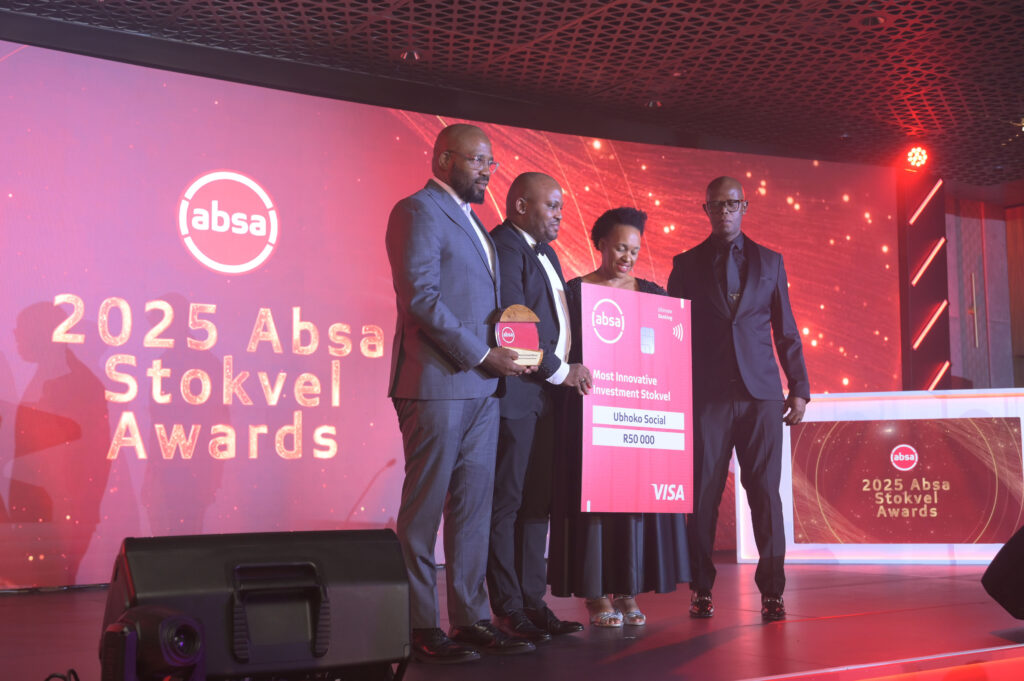
Winners of the 2025 Absa Stokvel Awards scoop major prizes for turning group savings into success

The best of the best of South Africa’s stokvel savers gathered at The Houghton Hotel in Johannesburg, on Saturday night, 29 November 2025, where the winners of the 2025 Absa Stokvel Awards were announced.

The awards, first launched by the diversified pan-African business in 2024, celebrated the outstanding achievements of the winners in seven categories.

Commenting on the high standards of the winners in each category, Tawanda Rumhuma, Executive: Savings and Investments at Absa Personal and Private Banking said, “These are our stokvel stars, who shine as beacons of excellence in their respective categories. We applaud them for their conviction that communities working together can help make individual and collective dreams come true. They’ve excelled at thinking out of the box and going the extra mile to inculcate something Absa actively promotes – that a culture of saving really works to uplift communities.”

Under the theme of Every Story Deserves a Stage, the event saw prizes of R50 000 per category being awarded, with those stokvels who hold an Absa Investment Club Account doubling their winnings with an additional R50 000, bringing their total reward to R100 000.

The winners of the 2025 Absa Stokvel Awards are:

  • Best Community Impact Award: True Love Movement (TLM) Club – This stokvel has made a meaningful contribution to its community through social projects, donations, and support initiatives. The initiative that this stokvel winner supports, will receive a further donation from Absa Citizenship.
  • Most Innovative Investment Stokvel: Ubhoko Social Investment Club – Recognising a stokvel that has successfully ventured into investments or innovation-driven initiatives, setting a benchmark for others.
  • Best Stokvel in Financial Literacy and Leadership: Mufhatu Stokvel – This stokvel exemplifies strong leadership and promotes financial literacy, empowering members to make informed decisions and achieve financial growth.
  • Best Stokvel Enablers: PR Investment Club – Recognising organisations or individuals who uplift and enable stokvel communities through resources, mentorship, and impactful support.
  • Best Digitally Empowered Stokvel: Lekgotla Social Club – This stokvel effectively uses technology to streamline operations, improve accessibility, and enhance member engagement.
  • Lifetime Stokvel Achiever Award: Basepedi Burial Society – This award honours a stokvel that has stood the test of time, demonstrating resilience, sustainability, and continuous improvement over many years.
  • Stokvel of the Year: Tshwelopele Ladies Club – This stokvel emerged as the overall winner, showcasing exceptional success and impact during the year.


Furthermore, Andrew Lukhele, Chairman of the National Stokvel Association of South Africa (NASASA) was honoured with a special award by Absa for his incredible contribution to the stokvel industry and their inclusion in the banking system.

Explaining the importance of the Absa Stokvel Awards, Rumhuma said, “Stokvels represent the values of trust, unity and resilience which are so important. Through these awards we also shine a light on modern banking solutions like digital banking, financial literacy and inclusive banking. We believe it’s part of our social responsibility to assist stokvel members wherever we can. Stokvels represent a powerful block in festive season spending power, and we recognise their impact and influence on the way household budgets work, underpinning the success of long-term planning to reach financial goals. It makes good financial sense.”

Rumhuma stressed that stokvels have evolved far beyond being year-end buying groups. “Modern stokvels go much further. They are the changemakers who use extraordinary innovation to uplift their members and achieve success. Some assist their communities with social projects or teach their members how to invest money. We love that stokvels are starting to provide financial literacy education for their members, using easily accessible cellphone technology to do so. This is a way of futureproofing their club and their savings.”

Despite 11 million South Africans contributing a massive R50 billion to stokvels each year, over 60% of stokvels don’t use the services of banks yet. “The benefits of opening an Absa Investment Club Account include increased security for their funds, no monthly management fees and gaining interest on their capital. Stokvels can access their accounts through online banking and easily track member contributions. It takes a lot of administration work away from the treasurers. It makes good stokvel sense.”

Rumhuma concluded by saying that the stokvels that were awarded prizes at the Absa Stokvel Awards 2025 served as proud examples to others.

“We all have a lot to learn from their members about discipline, determination and harnessing their courage to take that first step to gather community members together and say, ‘Let’s start. Together we can do this’.  At Absa we believe everyone is capable of starting somewhere. Under this year’s theme of “Every Story Deserves a Stage,” what would your stokvel’s success story be?”


For more information about the Absa Stokvel Awards, please visit www.absa.co.za/stokvelawards.

Categories
Media release

Absa Group Opens New Regional Office to Support Inclusive Growth and Sustainable Development

Absa Group Opens New Regional Office to Support Inclusive Growth and Sustainable Development

scroll for more

Absa Group has opened a new Regional Office in Gqeberha, as it continues to enhance its customer-centric approach to banking. The development reinforces Absa’s long-term commitment to the Eastern Cape and supports the bank’s ambition to advance inclusive growth and community empowerment in the province, having invested R180 million in the Bay area.

Located at 274 Cape Road, the new office establishes a dedicated hub for local businesses, corporates, and customers, bringing Absa’s specialist teams closer to the metropolitan area’s growing commercial base and expanding access to financial services, enterprise support, and regional economic partnerships.

“This office is so much more than a physical expansion. By establishing a stronger presence in Nelson Mandela Bay, we are creating a platform that brings our services closer to communities, supports local enterprises, and strengthens our partnership with the industries and institutions that drive the provincial economy,” said Shane Agnew, Interim Provincial Executive: Eastern and Southern Cape Province.

Absa recently engaged Honourable Babalwa Lobishe, the Executive Mayor of Nelson Mandela Bay Municipality, to reaffirm its commitment to a meaningful partnership that advances economic participation, financial inclusion and long-term regional development, highlighting a shared ambition with the mayoral office to collaborate for future growth and prosperity of the region.

The 274 Cape Road development, from where the former Newton Park Absa bank branch has also commenced trading, integrates a range of sustainable design and engineering principles and is being assessed for ‘Green Star SA – Interiors’ certification, positioning it among the most environmentally advanced commercial properties in the province. The interior design prioritises energy and water efficiency through high-performance lighting, smart control systems, and low-flow fixtures, supported by materials selected for low emissions and responsible sourcing.

In assessing the building for certification readiness, the project was evaluated against multiple criteria, including building management, energy and water performance, indoor environmental quality, resource conservation, transport access, land use and ecology, and innovation.

“Absa has set a target for 33% of its South African property portfolio to be certified as green spaces by 2030. Sustainability is central to how we operate, and we continue to reduce our environmental footprint, support South Africa’s transition to a low-carbon economy, and promote more responsible building practices across the market. This office allows us to lead by example and demonstrate what environmentally conscious investment can achieve,” said Marachel Bessenger, Absa’s Head of Occupational Health & Safety and CRES Risk.


Categories
Our stories Our Voices

A big question looms over COP30: If we cannot stop a warming climate, can we at least adapt?

A big question looms over COP30: If we cannot stop a warming climate, can we at least adapt?

scroll for more

By Msizi Khoza

Brazil has called on nations to prioritize honouring previous pledges ahead of COP30.

Climate adaptation financing was a major talking point at COP29 in Baku, Azerbaijan. Developed nations agreed to take the lead in raising the $300 billion required to start addressing the adaptation needs of especially poorer countries that are more vulnerable to adverse weather risks caused by rising temperatures.

In simple terms, adaptation seeks to reduce the vulnerability of social and ecological systems to climate change impacts and enhance their resilience and capacity to cope with these changes.

At Glasgow in 2021, rich nations pledged to assist developing nations and raise about $40 billion a year by 2025. However, the gap between commitments made and reality remains significant. Also, the bulk of these financial commitments goes towards mitigation and cutting emissions instead of adaptation.

Africa is particularly vulnerable to climate-driven water challenges due to its reliance on rain-fed agriculture, rapid urbanisation, and limited investment in resilient infrastructure.

In April 2022, more than a third of KwaZulu-Natal’s annual rainfall fell within 24 hours, killing over 400 people and crippling water treatment plants and drainage networks. Stormwater systems designed for gentler rainfall patterns were overwhelmed, contaminating supply lines and paralysing municipal services – with losses exceeding R20 billion.

More recently, in the Caribbean, Hurricane Melissa, a Category 5 storm, made landfall in Jamaica with sustained winds above 298 km/h, destroying homes, public infrastructure, and water systems. The scale and speed of the storm underscored the growing volatility of extreme weather events in both intensity and frequency.

The timing of the Hurricane, making landfall on the eve of COP30 in Belém, proved prescient: it mirrored the very urgency island nations have long voiced in demanding stronger adaptation finance commitments.

At the moment, developing countries receive less than 1/10th of the finance that they will need to adapt and cope with climate change. The 2025 Global Adaptation Gap Report, published annually by the UN Environment Programme (UNEP), describes the world as “Running on Empty” when it comes to adaptation finance. It highlights a severe “adaptation finance gap,” stating that developing countries need an estimated $310 billion to $365 billion per year for adaptation by 2035, while current international public finance was only $26 billion in 2023.

According to the Report, based on 2023 prices, the adaptation finance needs in Sub-Saharan Africa alone were estimated at $51 billion annually, while countries in South Asia, Latin America, and the Caribbean need a combined $156 billion each year to meet their adaptation needs.

The main issue with adaptation is that there typically are no dedicated cash flows that accrue, that can honour debt obligations. So, inherently, it becomes a more difficult problem to resolve using traditional financing instruments and methods.

According to the UN Environmental Programme, the adaptation finance needs of countries differ by income level. Low-income countries tend to focus heavily on agriculture and food, alongside energy and transportation.

Lower-middle-income countries prioritise infrastructure, water supply, and agriculture and food, with health and sanitation gaining importance.  Upper-middle-income countries, on the other hand, prioritise agriculture, but forestry, ecosystem and biodiversity, and water supply, also receive significant attention.

What developing countries are doing now is using non-concessional loans that attract higher debt service costs to address their adaptation needs. These are now making up a growing chunk of international public adaptation finance, raising the sovereign debt levels of vulnerable nations, especially here on the African continent.

It’s estimated that developing nations have a $4 trillion annual financing gap and a debt burden of $1.4 trillion they are currently servicing.

Infrastructure development is a cornerstone of economic growth, facilitating trade, improving access to essential services, and creating employment opportunities. However, if this infrastructure is not climate-resilient, it risks becoming a stranded asset or a source of increased vulnerability.

The debate on the importance of building climate-resilient water infrastructure to protect communities against shocks caused by climate change is often couched in technical jargon that sometimes fails to calculate the immense human and infrastructure costs when the eventuality occurs.

Developing countries need innovative financing solutions to readily address adaptation financing and protect critical infrastructure from the ravages of climate change without having to rely on expensive money.

So, what innovative financing models can be replicated across the continent to meet adaptation needs?

In South Africa, the National Treasury has announced it’s in talks with lenders to set up a Credit Guarantee Vehicle (CGV) for Infrastructure in 2026, initially capitalised at R10bn, to make it easier to partner with the private sector to de-risk investments as the country embarks on an ambitious R1.8 trillion infrastructure investment drive.

This model can be replicated across the continent to crowd-in investments into critical water infrastructure by the private sector instead of countries having to resort to sovereign loans for adaptation needs.

Climate shocks are intensifying, necessitating a paradigm shift in Africa’s approach to infrastructure development. By prioritising climate-resilient design, mobilising innovative financing, and strategically deploying infrastructure that supports both resilience and development objectives, African nations can safeguard their economic progress and build a more sustainable future.

Msizi Khoza is Managing Executive for ESG at Absa Corporate and Investment Banking.

Categories
Media release

Absa Champagne in Africa Festival Arrives in Cape Town for the First Time

Absa Champagne in Africa Festival Arrives in Cape Town for the First Time

scroll for more

Absa is proud to bring the 23rd edition of the Absa Champagne in Africa Festival to Cape Town for the very first time. Following an extraordinary Johannesburg celebration earlier this month, the festival now takes its next national step, debuting this Saturday, 22 November 2025 at the Norval Arts Foundation in Tokai.

This historic Cape Town edition marks the beginning of a broader vision: expanding the festival into multiple regions across Africa in 2026, taking French champagne culture and African luxury to new audiences across the continent.

Guests can look forward to discovering a curated selection of over 20 authentic French champagne houses, alongside two special moments introduced for the first time in Johannesburg and now brought to Cape Town:

  • Chef Wandile Mabaso’s French-made champagne, launched exclusively at this year’s festival, will be available for guests to taste, a milestone for African culinary innovation.
  • Limited-edition Rich Mnisi silk scarves and pocket squares, designed for the 2025 festival, will be available to purchase on-site as collectible expressions of contemporary African design.

With live music, art, and the signature Absa hospitality, the festival promises an evening that blends refinement, culture, and the joy of shared celebration.

As Absa continues to grow this experience nationally, and soon, across Africa, Cape Town becomes the next chapter in a story where French heritage meets African creativity.

Tickets for the Cape Town edition can be purchased via quicket here.

Stay connected and share your experience using #AbsaChampagneInAfrica

Raise a glass. Honour the craft. Celebrate the story.